

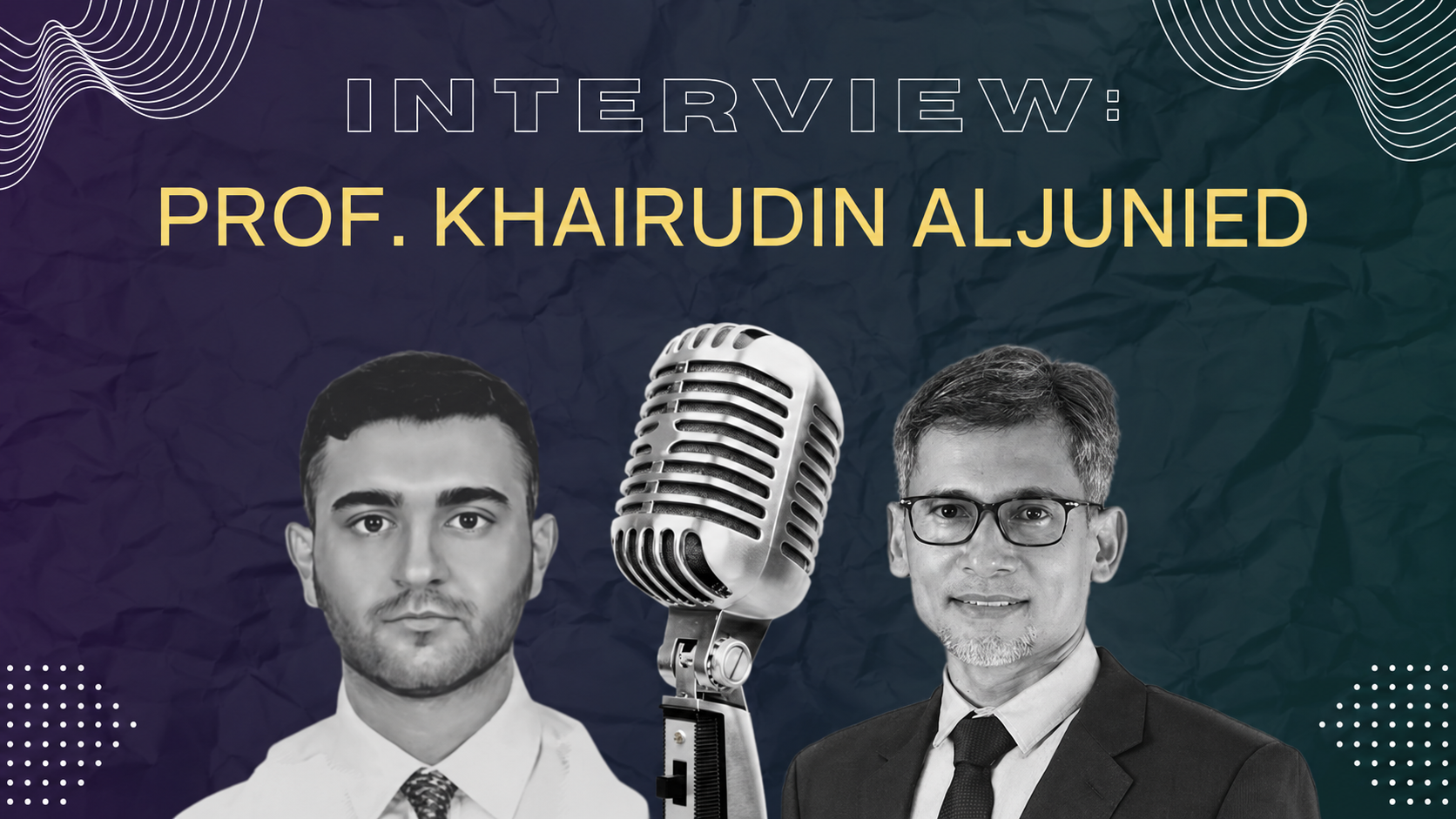
[English] Interview: Prof. Khairudin Aljunied – National University of Singapore & Georgetown University

Av. Semih Temizer
- Ekim 9, 2026
- 15 Min Read

Legal Reforms, Modernization and Future – Interview with Prof. Dr. Khairudin Aljunied
We’ve talked about “Legal Reforms, Modernization and Future” with Khairudin Aljunied. Prior to sharing our fruitful dialog, let me briefly introduce him…
Dr. Khairudin Aljunied (PhD SOAS, London) is a Professor of Islam in Southeast Asia at the International Institute of Islamic Thought and Civilization (ISTAC-IIUM). Prof. Dr. Khairudin Aljunied, a prominent scholar of Islamic intellectual history and Muslim societies, has been featured in The Muslim 500: The World’s 500 Most Influential Muslims in 2024, 2025, and 2026. He is concurrently an Associate Professor at the National University of Singapore and Senior Fellow (formerly and Professor as well as Malaysia Chair of Islam in Southeast Asia at the Alwaleed Centre for Muslim-Christian Understanding, Georgetown University). (Source: https://khairudinaljunied.com/)
Semih Temizer: Welcome dear Mr. Aljunied. I’d like to begin very quickly, let me ask my first question: Muslim societies have undertaken numerous legal reforms over the years. However, changing laws does not necessarily mean achieving justice. In your view, what were the most significant shortcomings of past reforms? What lessons should countries pursuing similar reforms today learn from these experiences?
Khairudin Aljunied: Past reforms have often failed because they began and ended with changing statutes while leaving structures of power untouched. Many were imposed from above by colonial administrations or post‑independence elites without consulting the people most affected: women, marginalized communities, rural populations. Laws were rewritten, but courts remained inaccessible, judges unaccountable, and social inequalities that produce injustice were never addressed. Reform was treated as a technical exercise, not a moral and social one.
The lesson for today is clear: justice is not inscribed in a text; it is lived in institutions and relationships. Reforms must be participatory—shaped by broad public deliberation, not just experts or rulers. They must also be holistic: you cannot reform family law without addressing poverty; you cannot promise equality before the law when access to legal aid is reserved for the wealthy. A law on paper is not justice, it is only the beginning of the struggle for it.
Semih Temizer: Well, that sounds a bit idealistic… As to societies, throughout history, Islamic law has been interpreted and developed in response to the needs of different societies. Today, however, tensions occasionally arise between traditional legal interpretations and modern legal principles. In your view, has Islamic law been able to develop a contemporary interpretation of interest and riba that adequately addresses the realities of today’s financial system?
Khairudin Aljunied: We have made genuine progress in rethinking riba, but we have not yet arrived at a fully adequate, systematically consistent framework. Early efforts rightly rejected outright usury and sought to anchor finance in profit‑sharing, partnership, and ethical risk‑taking which are principles deeply rooted in the Qur’an and Sunnah. Yet much of what is marketed today as “Islamic banking” is functionally indistinguishable from conventional finance, just recast with different terminology. We have avoided the label, but not always the substance.
A truly contemporary interpretation must do more than offer alternatives to interest; it must ask what ends financial systems should serve. Islamic finance should prioritise equity, redistribution, and the real economy over speculative profit. There is room for legitimate scholarly difference between those who take a strict textualist view and those who emphasise the spirit of the prohibition but that debate must happen openly, not behind closed doors in corporate boardrooms. We need interpretations that are both faithful to our principles and capable of serving ordinary people, not just investors.
Semih Temizer: Yes, needless to say we need interpretations… In many countries, the rule of law, judicial independence, and fundamental rights are constitutionally guaranteed, yet significant challenges remain in practice. What do you see as the main obstacles to legal reform in these countries? Where should the process of establishing lasting legal reforms begin?
Khairudin Aljunied: The greatest obstacle to meaningful legal reform is the gap between constitutional ideals and the exercise of power. Where constitutions are treated as ornaments rather than compasses, where executives control the judiciary, where laws are used to protect rulers rather than citizens, no written guarantee can deliver justice. Additional barriers include: deep social and cultural inequalities that skew access to justice; the legacy of colonial legal systems designed to govern rather than serve; and the capture of reform agendas by narrow elite interests.
Reform must begin not with new laws, but with the independence and accountability of institutions. It must start where the people are: with strengthening local dispute resolution bodies, improving access to justice in rural and underserved areas, and building a culture in which citizens know their rights and have the means to defend them. Legitimacy matters—reforms that are seen as imposed or self‑serving will not endure.
Semih Temizer: For many years, modernization has been discussed largely in terms of Westernization. Do you believe modernization necessarily requires following the historical path of the West, or can societies develop alternative models of modernization rooted in their own cultural and intellectual traditions?
Khairudin Aljunied: Modernisation is not the exclusive property of the West. It is a universal process of responding to new realities, but there is no single road to it. The mistake of the past was to equate modernity with Westernisation, to believe that to be “modern” one must adopt Western institutions, values, and even aesthetics wholesale, while dismissing one’s own traditions as backward.
Societies can and must build modernities rooted in their own intellectual and cultural resources. This does not mean isolation; it means selective engagement with the world on one’s own terms. It means taking science, technology, and democratic ideals where they serve human dignity, but grounding them in our own ethical frameworks derived from our Qur’anic vision of justice, our rich intellectual history, and our community experiences. A genuinely plural modernity will be one in which the Muslim world contributes its own voice, not merely echoes others.
Semih Temizer: As for social side of these, Ibn Khaldun explained the rise and decline of states not only through political developments but also through social and economic conditions. Drawing on his ideas, how might we understand the institutional challenges facing contemporary societies?
Khairudin Aljunied: Ibn Khaldun taught us that dynasties rise when social solidarity (asabiyyah) is strong, when rulers serve the common good, and when economies are productive and shared; they fall when solidarity frays, when elites become corrupt and detached, and when wealth concentrates in few hands. Today we see this logic playing out across the globe.
Many of our institutional crises stem from eroding social trust and growing inequality. When institutions are seen as serving only political or economic elites, when citizens feel excluded from decision‑making, the bonds that hold societies together weaken. Ibn Khaldun also warned that states decay when they prioritise short‑term gain over long‑term prosperity when they neglect education, public welfare, and infrastructure. For us today, this means: no amount of constitutional engineering will sustain a society if the people do not feel they belong to it, and it does not belong to them.
Semih Temizer: Alright, in the light of it, how sustainable can a process of modernization be when it is driven primarily by political leadership, without meaningful participation from society?
Khairudin Aljunied: History is unambiguous on this: modernisation driven solely from above rarely survives the leader who began it. Such projects may produce impressive infrastructure or rapid industrialisation, but they lack the most vital resource: public ownership. When people are treated as subjects rather than citizens, objects of policy rather than participants in shaping their future, they do not defend reforms when times turn difficult; they let them fall.
Sustainable change grows from the bottom up. It requires cultivating a capable, critical, and engaged citizenry. Leadership matters, but leadership must serve society, not replace it. Enduring modernisation happens when schools, universities, civil society organisations, and communities are empowered to lead, to innovate, and to debate. What is built by the few can be undone by the few; what is built by many is harder to dismantle.
Semih Temizer: Discussions of modernization often focus on the economy, technology, and state institutions. Yet intellectual freedom, critical thinking, and scientific research are equally important dimensions of this process. In your view, what are the main obstacles to the development of intellectual life in Muslim societies?
Khairudin Aljunied: We face a confluence of challenges: political pressures that suppress dissent and narrow what may be said. Educational systems that prioritise rote memorisation over critical inquiry. A climate fed by both conservative traditionalism and uncritical Western mimicry that discourages independent thought. When our scholars and thinkers are pressured to conform to religious orthodoxy on one hand, or to Western intellectual fashions on the other, genuine creativity suffers.
To revive intellectual life, we must free our universities and research institutions from political control and intellectual timidity. We must teach our youth to question, to debate, and to value the pursuit of truth over the comfort of conformity. We must also reclaim our intellectual heritage not as a museum piece, but as a living tradition that invites fresh reading, critical engagement, and bold new thinking.
Semih Temizer: Looking ahead, which fundamental issues do you believe need to be reconsidered in order to develop a new understanding of modernization?
Khairudin Aljunied: We must rethink what we mean by “progress”. For too long we have measured modernisation by GDP, technology, and state power. We must place human dignity, justice, and freedom at the centre. A new understanding must question: Who benefits from progress? Who is left behind? What do we preserve of our moral and spiritual heritage amid change?
We also need to decouple “modern” from “Western” once and for all, and to acknowledge that dignity, equality, and reason are not Western values, they are human values, values deeply inscribed in our own tradition. Our vision must be inclusive: it must give a full place to women, youth, minorities, and voices from every region. Modernisation should not be something that happens to us; it should be something we build together.
Semih Temizer: We are witnessing a period in which the global economic and political balance is increasingly shifting toward Asia. How do you think Asia’s rise might shape the future of the Muslim world?
Khairudin Aljunied: Asia’s re‑emergence as a global centre of power is not merely an economic shift. It is a civilisational rebalancing. For the Muslim world, it offers an alternative to the long‑standing binary of “East vs. West” and opens space for new solidarities. Muslim communities across Asia from Southeast Asia to Central Asia have long cultivated cosmopolitan, adaptive, and inclusive forms of Islam, shaped by our own regional histories.
Asia’s rise can amplify those voices. It can help us move beyond Middle Eastern‑centred definitions of what it means to be Muslim and modern, and offer models that are plural, democratic, and development‑focused. But this potential will only be realised if Asian Muslim societies speak with confidence, cooperate across borders, and invest in shared prosperity not just shared markets.
Semih Temizer: For many years, intellectual and political debates concerning the Muslim world have been largely centered on the Middle East. What new perspectives could the historical experiences and intellectual traditions of Muslim societies in Asia bring to discussions about the future of the Muslim world?
Khairudin Aljunied: The intellectual and historical experiences of Asian Muslims offer a vital corrective to narratives dominated by the Middle East. In Southeast Asia, for example, Islam took root through trade, dialogue, and cultural exchange not conquest. We have long practised syncretism in the best sense: embracing Islamic teachings while enriching them with local wisdom, and living peacefully alongside diverse faith communities. Our traditions have been inclusive, adaptive, and pragmatic.
These experiences challenge the stereotype of Muslim societies as inherently conservative or resistant to change. They show that there is no single “Muslim path”: our faith has flourished in many cultural languages; remind us that tolerance, pluralism, and peaceful coexistence are not modern import; are part of our Asian Muslim legacy.
Semih Temizer: What are the distinctive features of Türkiye’s experience of modernization that set it apart from those of other Muslim societies? Do you think there are lessons that other Muslim societies can draw from the Turkish experience?
Khairudin Aljunied: Türkiye’s experience is unique. It combined sweeping political, legal, and cultural reforms with a strong state tradition and a determination to situate itself at the crossroads of civilisations. At its best, Türkiye demonstrated that a Muslim‑majority society could build democratic institutions, a vibrant civil society, and a diversified economy, all while retaining a distinct Islamic identity. At its most troubling, it showed the risks of top‑down imposition: reforms that excluded broad segments of society or suppressed religious expression eventually provoked backlash.
The lesson is not that one model is perfect and another is flawed; it is that sustainable transformation requires reconciling change with people’s values and beliefs. Türkiye’s journey, with its achievements and its tensions, reminds us that secularism and faith, democracy and tradition, need not be enemies. They can coexist if there is genuine dialogue and mutual respect.
Semih Temizer: Given its historical legacy and geopolitical position at the crossroads of Europe, the Middle East, and Asia, what role could Türkiye play in advancing intellectual development, educational reform, and international academic cooperation across the Muslim world in the coming years?
Khairudin Aljunied: Given its geography, history, and academic capacity, Türkiye is uniquely positioned to serve as a bridge and a beacon. It can lead in building regional academic networks, supporting open intellectual exchange, and developing educational curricula that blend excellence with ethical grounding, curricula that respect both science and faith, both modern knowledge and our shared heritage.
Türkiye can also foster cooperation across divides, between East and West, between Arab and Asian Muslim societies, between secular and religious scholars. To do so credibly, however, it must remain committed to intellectual freedom and academic independence at home. Influence is earned through example, not asserted through power.
Semih Temizer: I guess we need to talk about AI now… Artificial intelligence and digital technologies are transforming not only economies but also education, legal systems, and social relations. How prepared do you think Muslim societies are for this transformation? What should they prioritize to avoid repeating the mistakes made during previous periods of modernization?
Khairudin Aljunied: We are only partially prepared. We have embraced technology as a tool for communication, for commerce, for education but we have been slower to develop ethical frameworks for guiding it. We risk repeating past mistakes: adopting the technology without the critical thinking to direct it; allowing it to widen inequalities rather than reduce them; and surrendering our moral agency to algorithms designed elsewhere.
Our priorities must be: digital inclusion ensuring rural and marginalised communities are not left behind. Ethical governance and the development of Islamic and human‑centred guidelines for AI and data use, and local innovation by training our own engineers and thinkers so that we shape the digital future rather than merely consume it.
Semih Temizer: While digitalization has made knowledge more accessible, it is also changing the influence of traditional religious authorities and educational institutions. How do you assess the growing use of artificial intelligence in the production and interpretation of religious knowledge, particularly in the context of Muslim societies?
Khairudin Aljunied: AI offers extraordinary opportunities: it can make vast archives of Islamic scholarship accessible to anyone; it can aid linguistic and textual analysis; it can democratise access to knowledge. Yet it also carries profound risks. If we allow algorithms to interpret our faith for us, we risk standardising religion, flattening its diversity, and sidelining the human element of learning and reflection.
Religious knowledge is not just information. It is wisdom, transmitted through living teachers, shaped by moral context, and enriched by debate. AI can be a tool, a helper, but never a substitute for the scholar, the student, or the community. Our task is to set boundaries: to use AI to expand understanding, not to replace it; to ensure it supports pluralism, not uniformity; and to keep the human voice critical, compassionate, and responsible at the heart of our religious life.
Semih Temizer: Thank you so much for all.
I would like to express my sincere gratitude to Prof. Dr. Khairudin Aljunied for sharing his valuable insights, knowledge, and perspectives with me in this interview. I hope our conversation has offered readers a deeper understanding of Muslim societies, Islamic intellectual traditions, and the ideas shaping our world today. Thank you, dear readers, for taking the time to join me in this meaningful exchange; I look forward to welcoming you again in my future conversations with distinguished scholars and thinkers. 10.10.2026
www.semihtemizer.com


